



What Could Increase Valuation Before Going To Market?
Increase Business Valuation Before Selling
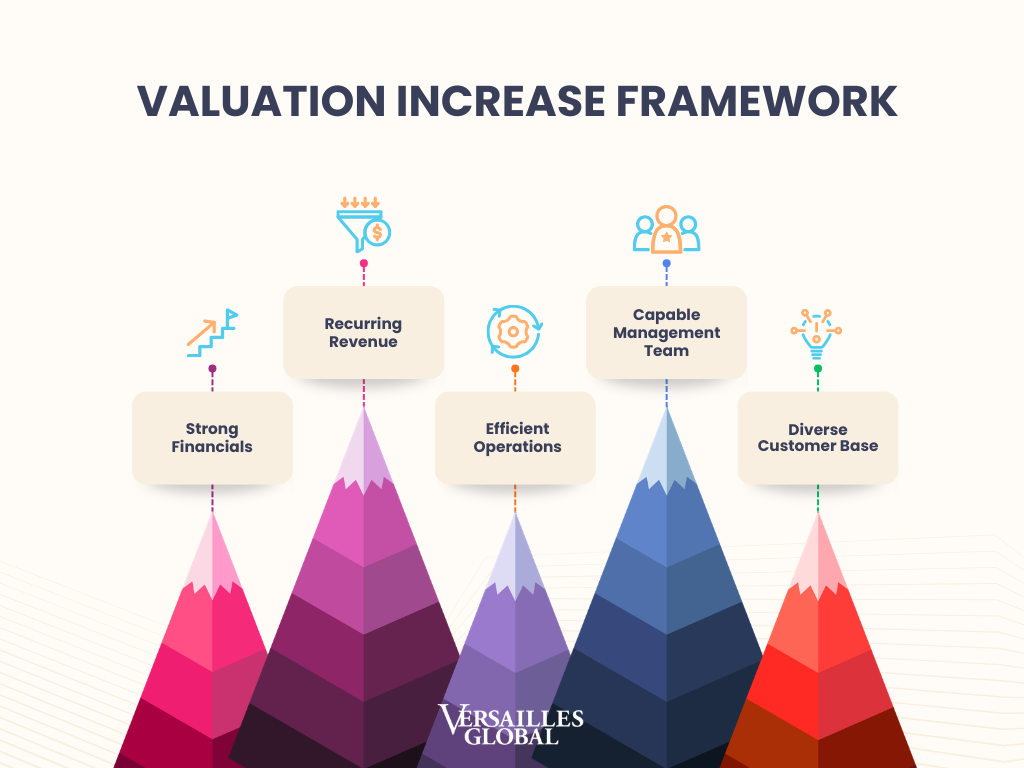
Business owners often focus on timing the market when considering a sale. In practice, valuation is shaped less by market timing and more by preparation. Buyers pay higher multiples for companies that demonstrate durability, transparency, and the ability to perform after ownership changes. The months and years leading up to a sale present a meaningful opportunity to strengthen these attributes and materially influence the outcome.
Strengthening the Financial Foundation
Few factors influence valuation more than the quality and credibility of financial reporting. Sophisticated buyers examine financial statements line by line, testing both accuracy and consistency. Companies that present clean, well-organized financials reduce perceived risk and accelerate diligence.
Preparation begins with ensuring accounting practices align with GAAP standards and that records are complete and current. Accounts should be reconciled regularly, documentation maintained for major transactions, and personal or discretionary expenses removed from operating results well before marketing the business.
Equally important is presenting sustainable earnings. Buyers focus on EBITDA margins, working capital discipline, and cash flow predictability. Normalizing earnings through clearly documented adjustments for nonrecurring expenses, owner compensation differences, or one-time events helps establish a reliable earnings base. Many sellers now commission a quality of earnings report prior to launch. This independent validation signals transparency and often shortens diligence timelines.
Balance sheet discipline also matters. Collecting aged receivables, addressing obsolete inventory, resolving disputes with vendors, and eliminating unresolved liabilities demonstrate operational control. Businesses that show consistent financial governance are frequently rewarded with stronger valuations and smoother negotiations.
Building Recurring and Predictable Revenue
Predictability remains one of the strongest drivers of valuation. Revenue streams supported by contracts, subscriptions, or ongoing service relationships reduce uncertainty and allow buyers to underwrite future performance with greater confidence.
Companies reliant on transactional sales can often introduce recurring elements well before a sale process begins. Service agreements, maintenance programs, subscription offerings, or membership models can gradually shift revenue toward greater stability. Even modest recurring revenue, if growing consistently, signals strategic direction and future scalability.
Buyers closely analyze recurring revenue metrics, including retention rates, customer lifetime value, and renewal trends. Long term agreements, automatic renewals, and solutions embedded within customer operations increase switching costs and strengthen revenue durability. Securing multi-year commitments from key customers prior to market entry can materially improve buyer confidence and valuation outcomes.
Demonstrating Operational Scalability
Operational maturity signals that growth can occur without a proportional increase in cost or complexity. Buyers place significant value on businesses that operate through systems rather than individual dependence.
Documented processes play an important role. Standard operating procedures, training materials, and defined workflows demonstrate that institutional knowledge is transferable. Companies that rely heavily on informal practices or owner oversight often face valuation discounts because buyers perceive execution risk.
Technology investment can further reinforce scalability. Integrated systems across accounting, customer management, inventory, and project tracking reduce operational friction and improve visibility. Eliminating manual processes and outdated systems before going to market lowers integration risk and strengthens the buyer’s investment case.
Operational metrics also receive close scrutiny. Improvements in gross margin stability, labor productivity, capacity utilization, and cost structure signal that management understands operational drivers. Addressing inefficiencies, renegotiating supplier arrangements, or optimizing facilities can enhance profitability while demonstrating readiness for growth.
Reducing Customer Concentration Risk
Customer concentration remains one of the most common valuation challenges in middle market transactions. When a single customer represents a significant share of revenue, buyers must account for potential loss following a change in ownership.
Reducing this risk requires deliberate diversification well in advance of a sale. Expanding into adjacent industries, new geographic markets, or additional customer segments can rebalance revenue exposure without weakening core relationships. The objective is not to replace strong customers but to reduce dependency on any single account.
Buyers also evaluate relationship quality. Longstanding customers with stable or expanding purchasing patterns carry more value than recently acquired accounts. Written agreements, documented renewal history, and measurable customer satisfaction indicators provide evidence of stability. A diversified and loyal customer base strengthens confidence in future revenue and supports higher valuation multiples.
Building a Management Team That Extends Beyond the Founder
A central question for any buyer is whether the business can succeed without its owner. Companies heavily dependent on founder relationships or day-to-day involvement often experience valuation pressure because continuity appears uncertain.
Developing leadership depth several years before a planned exit can materially change buyer perception. Strong operators across finance, sales, and operations demonstrate that performance is institutional rather than personal. Clear organizational structures, defined responsibilities, and succession planning reinforce this message.
Investment in leadership retention also matters. Competitive compensation structures, incentive programs tied to post transaction performance, and clear career pathways help ensure continuity through transition. Buyers frequently view capable management teams as platforms for future expansion, particularly in consolidation strategies.
As owners gradually step back from daily decision making, management has the opportunity to demonstrate independent execution. During diligence, buyers will evaluate not only competence but also engagement and alignment with future growth plans. A confident and committed leadership team often becomes one of the strongest contributors to premium valuation.
Preparation Creates Optionality
Improving valuation rarely depends on a single initiative. Instead, it results from reducing uncertainty across financial performance, operations, customer relationships, and leadership continuity. Each improvement lowers perceived risk, and lower risk translates directly into stronger pricing and broader buyer interest.
For many middle market companies, the most significant value creation occurs not during negotiations but in the preparation period before the business ever reaches the market.
About Versailles Global
Versailles Global is a leading independent boutique investment bank that provides expert M&A advisory services to entrepreneurs, private companies, private equity firms, family offices, large corporations, and governments. Our goal is to provide clients with outstanding results. Our senior-level bankers provide personalized and confidential services tailored to meet each client's unique needs.
More information on Versailles Global can be found at
For additional information, please contact
Donald Grava, Founder and President